Huawei Watch review

Huawei Watch review
Despite Huawei launching a plethora of good-looking, high-spec'd and generally well received smartphones over the last couple of years, the Chinese company is struggling somewhat to establish itself as a desirable brand outside of its homeland.
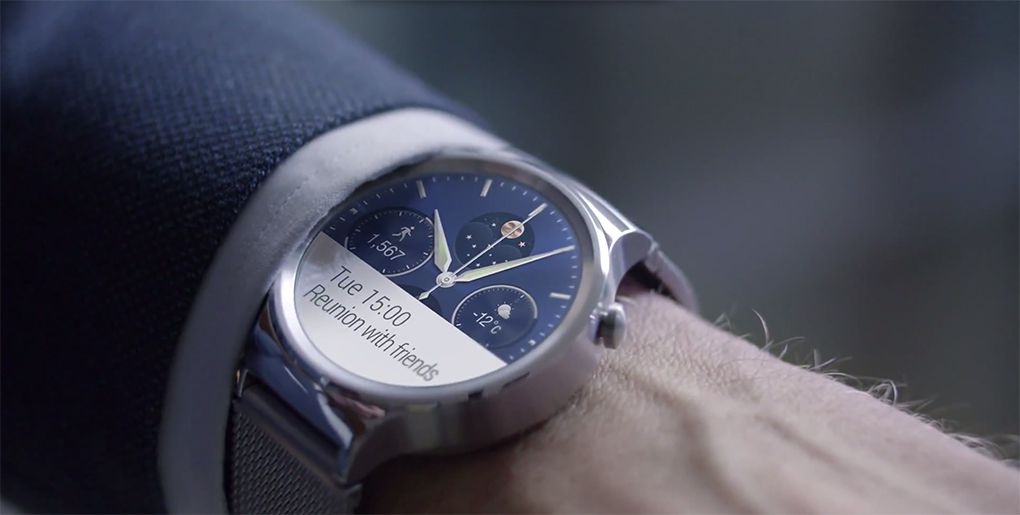


The Huawei Watch packs scratch-resistant sapphire crystal glass, like the Apple Watch, and a cold-forged, stainless steel unibody design. It comes in gold, silver or black and there are both fine-grain leather and cold-forged 316L stainless steel strap options.
This is no rubber and plastic hatchet job - the Huawei Watch is stylish and well-made. With a diameter of 42mm and a thickness of 11.3mm, it's a touch more compact than the Samsung Gear S2. The bezels are also just 0.6mm thick, so you get more display real-estate too – 1.4 inches compared to 1.37 on the littler Moto.
The rose-gold plated model – that we've also spent some time with – features a bezel with an extra textured finish, making it an altogether prettier wearable than the two plainer, minimalist watches. It glints in the light and feels more like a piece of - admittedly fairly weighty jewellery.
Essential reading:
Clearly Huawei is aiming to be the first genuine premium smartwatch from the Google stable but, while the hardened glass and the mix of leather and stainless steel are a million miles from the original Wear models from 2014 – we don't expe to be shaking in its boots.
High-end it may well be – luxury is certainly is not. Yes, it may be a touch fancier than the likes of the  and the , but it's not all that different, and certainly not as superior as its price-tag suggests.


Huawei Watch: Display


The Huawei Watch walks the round LG display path, rather than limping along Moto 's 'flat-tyre' avenue – in reference to the black dead area at the bottom of the 360's screen. The AMOLED display is a 1.4-inch 400 x 400 one with a ppi count of 286. That's the highest on any Android Wear device to date – although the soon-to-launch LG Watch Urbane Second Edition will trump it with a 480 x 480 panel at 348ppi.
Huawei's effort is made all the more impressive thanks to a 10,000:1 contrast ratio. Colours are vibrant, text appears crisp and it even holds up pretty well under bright-lights.
Side by side with the smaller Moto 360 2 – its closest rival in terms of aesthetics – it's evidently a better display. Not just because it offers genuine 360-degree visuals, but because everything just looks sharper. There's no ambient light sensor, however – so you'd always have to have the display to a preset brightness setting that doesn't account for your situation.
The display is always-on and there are almost 50 pre-loaded watch faces, not counting the hundreds officially on offer from Google Play. The supplied faces range from a little boring to quite vibrant, and certainly support the overall build quality.

Huawei Watch: Activity tracking

Huawei Watch review
Obviously, this being an sony smartwatch, Google Fit is pre-loaded on the device and will do all the things it would do on another Google-powered smartwatch. However, Huawei has decided to have a crack at the fitness front itself, with the Watch pre-loaded with the Daily Tracking app.
Essentially, it does the same thing, but with slightly nicer graphics. Once you enter your personal metrics, it will keep score of your steps, calorie burn and the amount of times you stand up during a day. You can set all your own goals and Huawei also claims the Watch will know whether you are walking, running or climbing – we had mixed results on this front though.
So far, so pointless – but thanks to Huawei's partnership with Jawbone, the UP platform is compatible for Huawei's smartwatch. You can select the Huawei Watch as your device within Jawbone's app and tap into its rich graphs and personal coaching platform, which is great – especially if you don't own one of the latest UP bands. And it's the Huawei fitness stats that are imported, not the generic Android Wear ones.
There's no GPS on board though – so you can't treat the Huawei Watch as a dedicated running assistant, as you can with the Sony SmartWatch 3 and the new Moto 360 Sport. For the price-tag we'd have expected this connectivity to be included.
Like many of its AW rivals, the Huawei Watch has an optical heart rate tracker and, like many of its AW rivals, it's a totally useless feature. It's just not accurate enough to rely on for a resting bpm reading and, because it will only count a pulse on very still wrists, it's an absolute waste of time when it comes to active heart rate monitoring.

Huawei Watch: Android Wear experience


It's becoming increasingly difficult to critique individual Android Wear devices as the usability generally boils down to how well you can get on with Google's wearable OS. Some people like Android Wear just fine, some people think it's the absolute pits. Opinion is even divided on the Wareable team.
However, what is clear that Android Wear is still very much a work in progress and is heavily reliant on the updates rolling out of Mountain View.
Essential reading:
The good news, with regards to the Huawei Watch specifically, is that it's bang up to date with the latest version of the smartwatch OS. That means Wi-Fi independence, the new Together features, and official iOS support. Yep – you can officially use the Huawei Watch with an iPhone. You'll get a stripped back experience mind; be sure to check out our guide .


Canon EOS 80D review

Canon EOS 80D review


The 80D's sensor and processor combination brings a native sensitivity range of ISO 100-16,000 (a third of a stop higher than the 70D), and a maximum expansion value of ISO 25,600 (the same as the 70D).
And while the maximum continuous shooting rate is the same as the 70D's at 7fps, the burst depth has been increased to 110 JPEGs or 25 raw files when a UHS-1 SD card is used; that's a significant step up from the 65 JPEG or 16 raw files possible with the 70D.
Canon EOS 80D
The EOS 80D has a new and improved version of the Dual PIxel CMOS AF system found in its predecessor, plus an increased resolution of 24 million pixels.

Modern SLRs have two autofocus systems, one for when using the camera conventionally and composing images in the viewfinder (i.e. in reflex mode) and the second for use in Live View and video mode. Canon has improved both of these systems for the 80D in comparison with the 70D.
The reflex mode system, for instance, has 45 AF points, all of which are cross-type, whereas the 70D has 19 points. This means the new camera has better AF point coverage, making it more able to find and follow subjects around the frame.
Furthermore, all of the points are cross-type with lenses that have a maximum aperture of f/5.6 or greater while the central 27 operate at f/8 and nine of them are cross-type at f/8. That's good news for anyone using telephoto lens/teleconverter combinations that reduce the maximum aperture to f/8.
The 80D can also use colour information from the 7560-pixel RGB+IR (infrared) metering sensor to help with subject tracking.

Turning to the Live View and video autofocus system, the 80D uses Dual Pixel CMOS AF technology like the 70D, which means it has phase detection points on the imaging sensor itself.
According to Canon the new system is more sensitive and faster than the one in the 70D, but because fast autofocusing often isn't desirable when you're shooting video, it's possible to vary the speed of the 80D's system over seven steps for slower focus changes.
Although the 80D lacks one of the most in-vogue video features – 4K recording – it improves upon the 70D's video offering with a headphone port for audio monitoring and the ability to record Full HD (1980 x 1020) footage at 50fps for 2x slow-motion playback.
Like the 70D, the 80D also has an external mic port (volume can be adjusted manually in-camera) as well as HDMI Mini and A/V Digital out terminals, but the 80D can record in MOV or MP4 format whereas the 70D can only shoot in MOV format. Canon's excellent Video snapshot feature is also on hand to help create more dynamic short films in-camera.
Canon EOS 80D
The NFC logo on the side shows the EOS 80D now has Near Field Communication for wireless connections to smartphones, tablets and Canon's CS100 Connect Station.

Canon got onboard with Wi-Fi connectivity in its cameras relatively early on, and it's now starting to include NFC (Near Field Communication) in new models – including the 80D. This enables the camera to be connected to an NFC enabled smartphone or tablet, the Canon Connect Station CS100 or other Canon cameras with just a tap.
As well as enabling images to be shared quickly to the internet, this connectivity enables the camera to be controlled remotely using Canon's free app. Furthermore, if the new EF-S 18-135mm f/3.5-5.6 IS USM lens is mounted and used with the Power Zoom Adapter PZ-E1 announced at the same time, the app can be used to zoom the lens from one focal length to another.
Canon introduced its Anti-flicker system with the 7D Mark II to help produce predictable exposure and colour when shooting under a light source that's prone to flickering (for example fluorescent light). This clever technology, which detects the frequency of the flicker and times shots so that they're taken when the impact on exposure and colour is minimal, has now made it into the 80D.
Another point worthy of note is that, like the 5DS/R and 1DX Mark II, the 80D has Ambience priority and White priority options for the automatic white balance system. Using the Ambience priority setting produces images that retain some of the colour created by the lighting whereas the White priority setting is intended to remove the colour cast.
The 80D's sensor and processor combination brings a native sensitivity range of ISO 100-16,000 (a third of a stop higher than the 70D), and a maximum expansion value of ISO 25,600 (the same as the 70D).
And while the maximum continuous shooting rate is the same as the 70D's at 7fps, the burst depth has been increased to 110 JPEGs or 25 raw files when a UHS-1 SD card is used; that's a significant step up from the 65 JPEG or 16 raw files possible with the 70D.


Samsung Galaxy Note 5 review

Samsung Galaxy Note 5 review
That makes it a huge leap over last year's galaxy note 4 , which backed the phone in cheap, textured plastic. Samsung's build quality is fit to compete with the aluminum iphon 6s and nexus 6p
Samsung Galaxy Note 5 review
The Galaxy Note 5 S Pen returns with new Air Commands

All of this comes at a cost, however. There's no microSD card slot for expandable storage or removable battery to swap out, like on the Note 4, , and very likely the forthcoming samsung
The Samsung Galaxy Note 5 is among the  in the world, but it isn't for everyone who can't grip a two-handed phone, or its compromises in the name of style.

Release date and priceu

Samsung Galaxy Note 5 review

The Note 5 may not be for everyone simply because it's currently only available in the US and Canada in the Western world. It launched in the US on AT&T, Verizon, T-Mobile, Sprint and US Cellular on August 21, 2015.
It hasn't come to the UK or the rest of Europe, but new rumors suggest it'll launch , with my guess being whenever Android 6.0 Marshmallow is ready for the phone. Samsung has focused on the  in the UK. For now, anyone outside of North America who wants a new phone with a stylus is out of luck.
Its price remains competitive, even with its fancy new design. It now costs $149 through a two-year contract on Verizon and Sprint after launching at $249 in the US. AT&T Next plans start at $24.67 a month, while the full retail Note 5 price is $696 via Verizon. It'll likely cost £600 in the UK, the same as the Note 4 price.

Design

The Samsung Galaxy Note 5 has the same basic shape as the Note 4, but the construction of the two phones couldn't be any more different.
Samsung Galaxy Note 5 review
Galaxy Note 5 (left) is smaller and more refined than the Note 4 (right)

Gone is the faux leather back that was made of plastic but felt more like cheap snakeskin. It's been replaced by a glass sheet that's infused into a metal frame, just like on the Galaxy S6.
At 153.2 x 76.1 x 7.6mm, the Note 5 dimensions are certainly bigger than Samsung's 5.1-inch flagship, but it's actually a hair smaller and noticeably thinner than the Note 4. It's lighter too, at 171g, shedding 5g, even with its metal-and-glass construction.
Its back glass also curves inward on the right and left sides. This smaller footprint and curved back made it easier to hold in my palm, despite its phablet size.
Samsung Galaxy Note 5 review
There's a curved glass back that makes it easier to hold

Glass does make gripping this 5.7-inch phone more of a challenge, breakable and a fingerprint magnet compared to its faux leather predecessor. There's less traction, but it's nowhere near as slippery as a super smooth aluminum with rounded corners.
Cases will help with the grip and prevent my overarching palm from interfering with the touchscreen, due to its ultra-thin bezel. This happens more often as bezels wane, phone sizes increase and my hands get fat. But I don't suggest Samsung's default case offering. I know from my time with the Galaxy S6 – its slick plastic makes the phone even more slippery.
Samsung Galaxy Note 5 review
Here are the Note 5 colors. You can only get two of them in the US

The Galaxy Note 5 colors include Sapphire Black, White Pearl and, as of November, Gold Platinum in select sizes in the US. Options for Titanium Silver are offered elsewhere. The aluminum frame is silver in all cases, with a color-matching power button on the right and volume rocker on the left. These buttons are thin, but feel strong when pressed and, importantly, are situated in the upper portion of the frame, exactly where my fingers clutch the phone.

Samsung Gear S2

Samsung Gear S2

Samsung Gear S2: Design

It's impressive how many bases Samsung has covered in just two designs: the standard Gear S2 and the upscaled Gear S2 Classic. It should be noted that the stainless steel and plastic editions look like watches and feel well made – and if you've ever worn a previous Samsung smartwatch, you'll know that is big news.
Samsung Gear S2 review
If we'd had a choice of which Gear S2 to review, we'd have plumped for the Classic. The ridged bezel, leather strap and smaller body combine for a premium feel, and it can be easily fitted with third party straps. It's $50 more expensive, but feels lovely.
We also haven't had a chance to test the Gear S2 with 3G and GPS – the obvious choice to compare to the Sony SmartWatch 3 or Moto 360 Sport if you want a smartwatch for everyday as well as running or training.
With two different designs and a bunch of different straps, there's some choice of style in the Samsung Gear S2 line-up, though it can't rival Apple or Motorola for personalisation options. While the Gear S2 Classic, with its leather strap, looks more in line with a Fossil watch, the plastic strapped Gear S2 has more in common with a Swatch. This is key for a couple of reasons. First, the Samsung Gear S2 doesn't try too hard. With its pre-loaded watch faces it looks fun and off-the-wall. It's not trying to be as classy as an Omega or as blingy as a Michael Kors. It has a confident style and it translates well.
One of our only criticisms here is that the 11.4mm thick S2 is still quite chunky and sits quite high on the top of your wrist. This is similar to the second gen Motorola and if there's one guarantee about the next generation of devices it's that they will be slimmer, but right now smartwatches are still chunky. The Classic will work for women but it wouldn't be our first recommendation. Still, one thing is for sure – we are so far away from the first Gear watch. This is a polished, unisex, circular smartwatch that no one will be ashamed of wearing. 

Samsung Gear S2: That rotating bezel

Samsung Gear S2 review
The Gear S2's rotating bezel is far and away our favourite thing about the piece. Rather than try to disappear the bezel altogether like Motorola or primp it up to look like a traditional wristwatch like LG, Samsung has transformed it into a satisfying, addictive and most importantly, intuitive way of interacting with the smartwatch.
When you move your hand to hover over the watch on your wrist it's the exact place your fingers land, even when you aren't looking down yet, and thanks to some clever UI design in its Tizen OS – more on that later – you can switch between apps, cycle back to notifications, change volume and brightness all in the same smooth motion.
In short, it's genius and – sorry, Samsung – we hope to see similar mechanisms on rival smartwatches.
It's faster than Apple's Digital Crown on the Watch and the touchscreen prods and gestures of Android Wear. You can control everything with your finger on the right half of the bezel (if you're right handed) which means you will always be able to see the whole display. 
Samsung Gear S2 review
The bezel's closest rival here is actually a little known Chinese watch, designed by Frog design, called theTicwatch which has a capacitive strip on the outer edge.
There are also two buttons on the right-hand edge of the round watch body: 'back' at two o'clock and 'home' at four o'clock. The first of these is in the perfect position, the second can be a bit annoying to shift your hand around to press. You can set a double tap of the home button to launch an app, such as the music player or maps, which is handy, though unlike say, a Pebble, in order to select an app or setting it's back to prodding the touchscreen.

Samsung Gear S2: Screen

Samsung Gear S2 review
With so much love for the rotating bezel you might forget to pay proper attention to the bright, vivid and sharp 1.2-inch Super AMOLED screen. It's smaller than some smartwatch screens and set into the watch so it doesn't look quite as modern as the Moto 360 2. But this just increases its retro/classic charm.
At 360 x 360 pixels, the Gear S2's screen has an impressive pixel density of 302ppi, which means you can choose to set the font very small and see more messages or notifications on one screen as you scroll through them. It's as pin-sharp as the smaller Apple Watch and it shows. And unsurprisingly for a Samsung product, it can go very bright – probably too bright, though, as most days we settled for a low, easily readable setting.

Samsung Gear S2: Tizen

Samsung Gear S2 review
Tizen has always been a gamble for Samsung but this time it has paid off. Unlike all the Android Wear watches from Huawei and LG and Motorola which benefit from recent updates but can't really move the category on, the Gear S2 is doing its own thing. And its thing is a damn well easy to use smartwatch OS. As easy to use, in fact, as our beloved Pebble OS.
The home screen is the watch face screen and you simply rotate left one click for recent notifications. Rotate right to get to a screen with an apps icon, settings, buddies (for quick messages) and S Voice. Keep rotating right and you can get easily glanceable information – weather, S Health progress, heart rate and information from third party apps. Choose the apps menu instead and Tizen makes the most of the circular screen and bezel with round app icons around the edge of the display to cycle through. Keep going with the bezel and it simply takes you to the next screen of apps. It is much quicker than zooming in and out with a Digital Crown.
Notifications are there, messages are there, call logs, third party apps… You can't get lost. One niggle is that images, say from WhatsApp, don't display on the watch but this can be excused for the time being. Tizen performs well too with no lag between transitions – the only thing that keeps you waiting is animations when apps open. Unlike Android Wear, the music player controls work without fail every time. With alerts, the vibration is quite subtle – not refined subtle like Apple's Taptic Engine but more in a you-might-miss-it kind of way. You can set the Gear S2 to long vibrate and there are levels to choose from but even 'strong' isn't that strong.
Our only criticism is that it would be great to be able to customise the aesthetic of the whole UI – it looks a little clownish and in particular will probably look a little odd on the Classic. Apple's watchOS 2 is colourful but looks more suited to a stylish accessory and watches such as the Olio Model One are offering bespoke watch faces and UIs custom to each finish.
Samsung Gear S2 review
Like the Apple Watch, it's missing the contextual alerts of Google Now which can be really handy, but arguably what Tizen offers is – for now – more useful; a quick way to find out and access what's happening. What we really want is a blend of the two – Google's virtual assistant is the future but Android Wear is still a work in progress after 18 months. Outside of Apple and Google, Samsung has obviously been looking elsewhere for its services and maps are taken care of by HERE Maps. It's generally accurate and you can zoom in and out of your location using the bezel but it can be rather slow to load on the watch. Directions are handled by a separate HERE app, Navigator.
Tizen supports Bluetooth – the S2 works with most Android phones, another first for a non-Wear Samsung smartwatch. It also has Wi-Fi on board – pull down to see if it's in 'standalone' mode or paired to a phone – as well as NFC for Samsung Pay, its mobile payment service which is a hit in Korea, just launched in the US and is coming to the UK. We'll update this review with our impressions of using Pay with the Gear S2 very soon.
There is also the small matter of the 3G and GPS Gear S2 with a bigger battery but we haven't seen this model yet, and according to a Samsung exec it's not due to come to the UK or Europe.

Samsung Gear S2: Health and fitness

Samsung Gear S2 review
So many health and fitness features are bolted onto smartwatches these days, we'll focus on what Samsung does well. Step counting is accurate and S Health offers some easily glanceable graphics to show your progress to specific goals set in the smartphone app.
If you want to be more active, the Gear S2 can vibrate to remind you you've been sitting down for nearly an hour and also give you the time you've been inactive as well as active – all useful, motivational stuff. Other alerts include step target achieved and healthy pace. You can also input that you've drank a glass of water or cup of coffee with one tap (once you've reached that screen with the bezel) which is exactly the kind of thing a smartwatch can help with.
The S2 isn't going to replace your sports watch, especially as neither the regular nor Classic models have GPS, but there are some attempts to give you that option. It auto tracks walking, running and cycling, with estimates of calories burned, which is perfect for the kind of casual user who would consider the Gear S2 as an all-rounder. Though it did detect our evening jog, it also had a blip when it once – only once – classed sitting on the sofa as light activity. Nike+ Running is also preloaded and is a better choice for regular runners as it shows time, distance and pace right on the watch face.
Samsung Gear S2 review
The heart rate monitor on the underside of the Gear S2 is a cut above too, and while it's no more accurate than the tech you'll find on an Android Wear watch, it's a lot more useful. It can take on the spot readings and can also be set to continuously take your pulse at intervals with two settings, moderate or frequent.
When you're not exercising, you can also tag your bpm readings as 'resting', 'before exercise', 'after exercise' or with moods such as 'excited' and 'angry' so you can keep an eye on your heart's health. The app also lets you know if your resting heart rate is average or lower/higher than average, though the stats get annoying fairly quickly.
All-in-all, the S2 offers more than Android Wear or Pebblein terms of health and fitness tracking. It's similar to what the Apple Watch is offering, partly successfully, but if Cupertino does decide to include GPS on its next model, the Gear S2 could get left behind. 

Samsung Gear S2: Apps

Samsung Gear S2 review
Here's the part of the Tizen gamble that might not pay off. There are a handful of preloaded watch faces to choose from – both analogue and digital style, customisable and some with 'complications' to show the date, the weather or whatever you want instant access too. 
As for apps, Samsung promised over 1,000 Tizen apps designed for the Gear S2's circular screen and it gave developers plenty of notice to get them ready. What we have is a bunch of big names like Nike, CNN, Yelp and Twitter as well as some smart home control options, and then a lot of, shall we say, interesting apps to sift through. Interesting may be generous.
You can head to the Samsung Gear Apps store via the Samsung Gear app to see the limited selection for yourself, but chances are you won't be too impressed. For instance, there's no Uber app yet, though you can obviously order a cab on your phone then get the alerts to your smartwatch until the app arrives.
Pebble's indie app store took time to get going, but despite the healthy community and the decent Kickstarter sales, it hasn't come close to Android Wear or Apple. 
But this is Samsung and the Gear S2 has the potential to outsell all Android Wear watches. We haven't seen anything available for Tizen so far that pushes the boundaries of what smartwatches can be great at – we're thinking of Google's two way translation app, say, or the text based games on the Apple Watch. But it's still very early days, so we will only say that if you think apps will be a big part of your smartwatch experience, it might be wise to wait or look elsewhere.

Samsung Gear S2: Battery life and charging

Samsung Gear S2 review
The battery life on the Gear S2 is better than most smartwatches. Of course it depends how you use it – whether you go for the always on screen, how much you use apps like S Voice and Maps, etc. But when using the S2 as much as we've used  day to day, Samsung's smartwatch is the one left standing. The 300mAh battery inside is officially good for three days – we haven't got more than two and a bit days out of it, even without the screen 'always on', but we're sure it can go for longer with lighter use.
To find out the battery level, you swipe down from the watch face, exactly the same as on Android Wear. Especially worth mentioning is the superb Power Saving mode. We left the house on 15% battery one morning having forgotten to dock the S2 in its tidy wireless charging dock overnight. We popped power saving on and it got us home from work before the Gear conked out. This switches the watch face to a simple grayscale screen, disables everything apart from alerts, calls and messages and turns off Wi-Fi. In short, it's wonderful and it means you won't be wearing a blank circle on your wrist on your commute home.
As for that dock, it's the spitting image of the Moto 360dock (a little smaller) and helps to build charging into your daily routine. The only annoyance comes with needing to charge your watch at work or when travelling but nine times out of ten, we prefer this kind of dock to a random proprietary cradle.

Noir Z9 Review


Some fast specifications of QMobile Noir Z9:

Dimensions (142 x 68 x 5)mm
Weight97 grams
Memory2 GB RAM, 16 GB ROM
Processor1.2 GHz Quad core processor, Qualcomm Snapdragon410, MSM8916
ConnectivitySingle SIM–Nano SIM, 4G-LTE 41Mbps
Camera8 MP LED Flash Rear Camera + 5MP Selfie Camera
Display4.8″ AMOLED HD Display
Battery2000 mAh, Li-ion technology
Features Anti Finger Print Technology, Corning Gorilla Glass, GPS, Google Search, Maps, YouTube, Calendar, etc
Price25,000 PKR

Pros and Cons:

Like every device, QMobile Noir Z9 also have pros and cons that customers use to watch for.
Pros:
  • Being the sleekest of all the smartphones nationwide and 2nd to OPPO R5 worldwide.
  • Corning Gorilla Glass.
  • Anti Finger Print Technology
  • Qualcomm processor Snapdragon 410
  • Weight is just 97 grams and is the first 4G-LTE device with weight below 100 grams.
Cons:
  • Its not a dual SIM.
  • Memory is though larger i-e 16 GB but it can’t be expanded with a memory card because QMobile Noir Z9 doesn’t have any memory card slot at all.

Design and Display of QMobile Noir Z9:

QMobile Noir Z9 is designed with the best. As it is a recent outcome of the Z series and nearly all the Z series are the flagships for QMobile. So a lot effort is needed to create new patents with new innovations and a module with new features. The dimensions of the sleek Noir Z9 are (142 x 68 x 5)mm. The edges are smoothly curved. Both sides are flat. The back cover is not removable and is glassy. A silver ring moves at the sides and covers the device at 360 degrees that enhances the look of Noir Z9. Noir Z9 is a complete black package with complete black accessories in the box.
The display of QMobile Noir Z9 is a 4.8 inches AMOLED HD display with resolutions of (1280 x 720) pixels. The refreshing rate of Noir Z9 is 60.0 and the density pixels are 320 at both X and Y axis. The GPU of Noir Z9 is driven by Adreno (TM) 306 with frequency range in between 200MHz~400MHz.

Processor of QMobile Noir Z9:

Powered with a fast Quad core processor of Qualcomm Snapdragon 410 that is clocked with 1.2 GHz frequency. The tasks are divided in between the quad cores that executes them and aggregate the results in no time. The chip-set is of Qualcomm and the chip-set model is MSM8916. Frequency ranges from 200~1.2 GHz. The GPU is Adreno (TM)306.

Memory for QMobile Noir Z9 Review:

QMobile Noir Z9 has 2 GB DDR3 of huge memory that is the need of the day and QMobile does have the knowledge of: How important is the RAM for a smartphone and how fluent is the switching in between apps and games with 2GB RAM. The ROM of QMobile Noir Z9 is 16 GB and 16 GB internal memory is much more for a normal use. QMobile Noir Z9 lacks memory card port and users have to compromise with the 16 GB ROM in Noir Z9.

Camera within QMobile Noir Z9 Review:

QMobile Noir Z9 has dual cameras. The Rear cam is 8 MP Auto Focus and is supported with a USB flash light. The interface of the rear camera is shown in the image below.
QMobile Noir Z9 Review
Rear Camera of QMobile Noir Z9:
The 8 MP Rear camera takes beautiful images. The size of its 8 MP Rear cam image is nearly 3.31 MB and the dimensions are (3200 x 2400) pixels. Following is the image been taken with the rear camera of QMobile Noir Z9. Click the image for full view.
QMobile Noir Z9 Review
Front Camera of QMobile Noir Z9:
The 5 MP Front camera also takes better images and can be used for taking selfies and social media video chats like Facebook, Skype, IMO etc. The size of its 5 MP Front cam image is nearly 1.54 MB and the dimensions are (2592 x 1944) pixels. Following is the image been taken with the Front camera of QMobile Noir Z9. Click the image for full view.
QMobile Noir Z9 Review

Network/ Connectivity of QMobile Noir Z9 Review:

QMobile Noir Z9 is a mono SIM smartphone that takes a Nano SIM in its one-and-only sim slot. There is no space for microSD Card and users have to deal with the 16 GB internal memory only. QMobile Noir Z9 is also 4G-LTE supported and it can have a peak download of up to 50 Mbps and a peak upload of up to 5 Mbps that is huge data to be transferred in between.

Battery performance and Internal Storage of QMobile Noir Z9:

The feathery slim and sleek Noir Z9 has been powered by a 2000 mAh battery that runs quite well with the Qualcomm Quad core processor and 2 GB RAM and 16 GB ROM. The battery may be consumed with a faster rate once the device is on the 4G-LTE mode or tethering mode. The battery gives you talk time up to 8 hours and up to 345 hours on stand by mode. The third snapshot shows the internal storage of 16 GB inside Noir Z9 which isn’t been supported with a SD Card.

External Images for QMobile Noir Z9 Review:

Featuring a razor thin body of 5mm, QMobile Noir Z9 is a design marvel. Noir Z9 is a handy device from all angles. Being shaped in an aluminium body with a smooth sensation. The back and front are flat end to end. The box contains a super duper flip cover that is different from all others, a super charger of 1 amp charge capacity along with a flat flexible data cable. The hands free are also unique and are sent with the perfect match of HD Audio sound system of QMobile Noir Z9.

In-hand images for QMobile Noir Z9 Review:

Carved from Aircraft Grade Aluminium, the noir Z9 is robust as well as light. Noir Z9 has a better look in hand and is a strong and durable device. Noir Z9 also has another feature of Automatic Polishing for superior finish. Consider the most sleek and fine device in the sole of your hand.
Below mentioned are the side wise dimensions and the look of this stylish smartphone, Noir Z9.

Interface Experience for QMobile Noir Z9 Review:

The interface is similar to the interface of QMobile Noir Z8 and QMobile Noir X950. The keyboard and the dial pad been used are the standard ones with the default layouts. The last image shows the camera interface and the features feed in the camera.
Experience brilliance in true HD on the 12.19cm (4.8) HD AMOLED Screen of the QMobile Noir Z9. Keep scratches at bay with the Corning Gorilla Glass 3 protection, which also makes it slimmer by 42.8%.
  • 12.19cm (4.8) HD AMOLED screen
  • Corning Gorilla Glass 3
  • 1280*720 Screen Resolution
  • 8,000,000:1 Contrast Ratio
  • 16.7M Colours
  • 30% power saving
Integrates its touch response layer into the display itself using ‘Oncell’ technology thus making it slimmer.

Bench Marking QMobile Noir Z9:

As QMobile Noir Z9 is powered by a Quadcore processor which is clocked at 1.2 GHz, a 2 GB RAM and 16 GB ROM along with 8 MP Rear and 5 MP front camera. Thus we can expect a better total in the mid-range smartphones and as expected, the results are better and Noir Z9 takes above 21 thousands score with Antutu which is at its best in the mid-range smartphones. QMobile Noir Z9 has been tested with Antutu, Vellamo and GPU bench mark to check for its different modules and features.

Antutu’s approach for QMobile Noir Z9 Review:

A score of over 21 thousand is a big total for a mid-range smartphone with a 1.2 GHz quadcore processor, 2GB RAM and 16 GB ROM. Internationally compared with international brands, QMobile Noir Z9 makes its place just below ASUS Zenfone 5.

Vellamo’s approximation for QMobile Noir Z9 Review:

Vellamo is a free app that checks your browser’s speed and performance, single core performance and multi-core performance individually. The overall scores are better enough.
  • With its metal part, Noir Z9 makes a total of 842 which hits down smartphones like Motorolla Droid Razor, LGE Nexus 4, Motorolla Moto G and Samsung Galaxy S3. Noir Z9 follows Asus Nexus 7, LGE Nexus 5 and others internationally.
  • For its multi-core performance, QMobile Noir Z9 has a better intra-processor communication and makes 1232 score in total. Leading LGE Nexus 4, Motorolla Droid Razr and Samsung Galaxy S3 and following Motorolla Moto G, Asus Nexus 7 and others in the international rank.
  • For its browser’s bench mark, QMobile Noir Z9 makes a total of 2013 which is best for the mid-range smartphones.

Comparing score of QMobile Noir Z9 with Samsung Galaxy S3:

Comparing the performance of QMobile Noir Z9 with Samsung Galaxy S3, We get the following results as shown in the snapshots below.

Checking the (GPU) graphics performance of QMobile Noir Z9:

Powered with the best Qualcomm’s Quad core processor Snapdragon410 processor with the graphics driver as Adreno (TM) 306. Making score over 11,500 is a big total and has the following results. The comparison has been made with QMobile Noir i9 which was also a device with better display.

add